

Why Does Wheel Count Matter in a Roller Assembly?
Wheel count is only one line in a roller specification. Buyers also need to know how the wheels sit in the housing, how they meet the track, and whether the finished unit fits the space prepared for it.
A Single Wheel Roller Assembly usually places one wheel in a bracket or housing. A Double Wheel Roller Assembly places two wheels in one unit, and how they are arranged depends on the product. Neither is better in every situation. The equipment's own design requirements decide which one fits.
What Is the Difference Between Single-Wheel and Double-Wheel Assemblies?
The parts inside each type are similar. What changes is how they are arranged.
How Is a Single-Wheel Roller Assembly Constructed?
A typical single-wheel unit includes:
- One roller wheel
- A bearing
- A shaft or axle
- A metal bracket or housing
- Mounting holes or another fixing structure
The Machined Steel Sliding Window Single-Wheel Roller Assembly with Stamped Bracket from HUNE follows this pattern. It combines one machined steel wheel with a central bearing and shaft, and a stamped iron bracket with electroplated surface treatment. Mounting holes sit at both ends of the bracket. The unit is intended for matching sliding window track systems.
How Is a Double-Wheel or Tandem Assembly Arranged?
A double-wheel unit holds two wheels in one assembly. It usually has:
- Two roller wheels
- A shared housing or supporting structure
- Bearings and shafts, according to the design
- Mounting holes or slots
"Double-wheel" and "tandem" are not two separate product categories. Double-wheel describes the wheel count. Tandem describes the arrangement, with wheels lined up one behind another in the same unit. The 158 mm Tandem Sliding Door and Window Roller Assembly in the same product range is an example of both at once. It has two wheels placed along the length of a slim metal housing, and the housing has mounting holes and slots.
The wheels sit in line, not side by side. A Tandem Roller Assembly of this kind runs on one path, so spacing and alignment along the track matter more than width across it.
Single Wheel vs. Double Wheel: What Are the Main Structural Differences?
| Comparison Point | Single-Wheel Assembly | Double-Wheel Assembly |
|---|---|---|
| Wheel quantity | One wheel | Two wheels |
| Basic structure | One wheel with its supporting parts | Two wheels within one assembly |
| Installation space | Depends on wheel and bracket dimensions | Depends on the combined housing and wheel arrangement |
| Track contact | One wheel contact position | Two wheel contact positions |
| Mounting structure | Designed around one wheel | Designed around two wheel positions |
| Main consideration | Wheel profile and mounting compatibility | Wheel spacing, alignment and housing dimensions |
| Selection focus | Available space and track matching | Overall layout and track compatibility |
Does Having Two Wheels Change Load Distribution?
It changes the contact pattern, but it does not tell you the capacity. Two wheels mean two contact positions on the track. How force is shared between them depends on several things:
- The distance between the wheels
- The flatness of the track
- The mounting position in the frame
- The structure of the housing or bracket
- The bearings, shafts and track that carry the force
The two wheels may not share the weight of a door or sash equally. For this reason, a double-wheel unit should not be assumed to carry some multiple of a single-wheel unit. Capacity belongs to the complete assembly in its working system. Ask for rated-load information on the full unit instead of judging by the number of wheels.
Does Wheel Arrangement Affect Installation Space?
Yes, and each structure raises its own questions.
- A single-wheel unit needs room for wheel diameter, wheel width and the bracket.
- A double-wheel unit needs the same, plus the distance between wheels and the total housing length.
- Both must fit the existing frame or equipment structure.
Appearance and wheel count cannot confirm that a unit will fit. A drawing or a measured sample can.
Where Are Single-Wheel and Double-Wheel Assemblies Used?
The two products described above show how each structure applies to real sliding systems.
Sliding Window Systems: A Single-Wheel Configuration
In the single-wheel unit, one steel wheel works with a bearing, shaft and stamped bracket. The wheel contacts the matching track so the sash can slide, and the bracket connects the unit to the window's mounting structure. When reviewing this type, buyers usually check the groove shape, hole positions, bracket size and track match.
Sliding Door and Window Systems: A Tandem Configuration
In the 158 mm tandem unit, two wheels run along the housing, and the whole unit is installed in the corresponding door or window structure. Wheel spacing, housing length, mounting holes and slots, and track structure all need checking. Real running behavior depends on how the entire sliding system works together, not on the roller alone.
Can These Designs Be Used in Other Equipment?
Other guided-motion equipment may use one wheel or several, but the design depends on that equipment. A door or window roller should not be assumed to suit other machinery. Wheel material, bearing, bracket, mounting method and operating conditions would all need to be confirmed again.
How Should Buyers Choose Between Single-Wheel and Double-Wheel Designs?
Choosing by structure and fit works better than choosing by a fixed idea of which type suits which job. Neither design belongs to a set duty level. The suitable choice comes from the product structure and the full system around it.
Start With the Equipment Structure
Collect these basics first:
- The overall structure of the door, window or equipment
- The position where the roller will be installed
- The space available around it
- The shape and size of the track
- The way the assembly will be fixed
Check the Required Load and Operating Conditions
State what the unit actually has to do:
- The load it needs to carry
- How often the equipment moves
- Whether impact or side force occurs
- Whether dust, moisture or similar conditions are present
- Whether a rated load has been specified for the project
Wheel count cannot answer any of these. Only the complete assembly's data can.
Compare Wheel and Track Compatibility
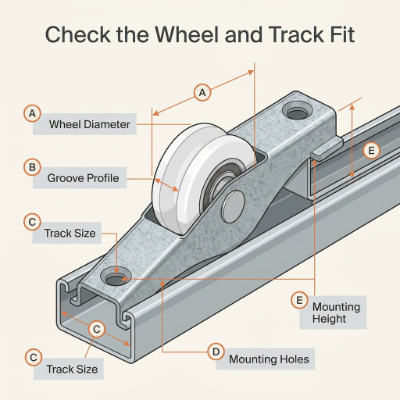
These dimensions decide whether a unit seats properly and moves smoothly:
- Wheel diameter: affects vertical fit and clearance.
- Wheel width: affects how the wheel sits on the running surface.
- Groove profile: should follow the rail shape.
- Track dimensions: set the limits for the other measurements.
- Wheel spacing: applies to tandem units and influences alignment.
- Mounting height: determines how the unit sits in the frame.
A small mismatch in any one of them can change how the wheel contacts the track, so measure them together.
Consider Maintenance and Replacement
When replacing an older part, record:
- The number of wheels on the original
- The bracket or housing shape
- Mounting hole positions
- The bearing and shaft structure
- How the groove meets the track
Two parts that look alike may not swap directly. An old sample or its drawing is the most reliable basis for confirmation.
What Information Should You Provide When Ordering Custom Roller Assemblies?
Clear input shortens the development conversation. Prepare the following.
| Information | Why It Matters |
|---|---|
| Wheel quantity | Confirms the required structure |
| Wheel dimensions | Helps identify the correct wheel size |
| Groove profile | Determines track compatibility |
| Bearing requirements | Defines the rotating support arrangement |
| Bracket drawing | Clarifies the mounting structure |
| Mounting hole positions | Helps confirm installation compatibility |
| Material preferences | Supports component selection |
| Application details | Helps evaluate actual working conditions |
| Sample or reference drawing | Reduces uncertainty during development |
Can Suppliers Develop a Roller Assembly From Drawings?
Often they can. A common path looks like this:
- The buyer provides drawings, samples or application details.
- The supplier reviews the wheel and bracket requirements.
- Both sides confirm the component structure.
- A sample is developed and its dimensions are evaluated.
- Installation compatibility is checked.
- Production arrangements follow once the design is confirmed.
Drawing discussions, sample confirmation and customization support are all part of this process. Scope and timing are agreed for each project.
Frequently Asked Questions About Single-Wheel and Double-Wheel Roller Assemblies
What Is the Difference Between a Single-Wheel and Double-Wheel Roller Assembly?
A single-wheel unit holds one wheel and has one contact position. A double-wheel unit holds two wheels with two contact positions. Housing, mounting structure and space requirements change accordingly.
Does a Double-Wheel Roller Assembly Always Have a Higher Load Capacity?
No. Capacity depends on the complete structure, including materials, bearings, bracket, track and how force is applied. A Double Wheel Roller Assembly should be judged by its rated data, not its wheel count.
What Is a Tandem Roller Assembly?
It describes wheels arranged in a line within one unit. A two-wheel tandem unit is therefore also a double-wheel unit. The exact structure should be read from the product drawing.
Can a Single-Wheel Assembly Be Replaced With a Double-Wheel Assembly?
This cannot be assumed. Check installation space, track, bracket structure, wheel positions and fixing method first.
What Should Buyers Check Before Ordering a Custom Roller Assembly?
Check wheel size, groove profile, bearing, bracket, mounting holes, material and real working conditions. A sample or drawing supports the review.
Which Roller Configuration Fits Your Equipment?
The two structures differ in contact points and mounting:
- A Single Wheel Roller Assembly has one rolling contact point and its own mounting requirements.
- A double-wheel, or tandem, unit has two wheel positions within one assembly.
- The right choice depends on equipment structure, available space, track compatibility and verified operating requirements.
- The complete assembly deserves evaluation, not the wheel count alone.
HUNE offers a single-wheel sliding window roller assembly and a 158 mm tandem door and window unit. To find a suitable structure, share your drawing, sample and application details so both sides can review the fit together.